13 May 2021

The real cure for eye strain: More experiences


The Real Cure for Eye Strain : More Experiences from People Around the World

This article lists experiences of other people with severe eye pain. This is a followup on my earlier article about the cure for eye strain (including the need to check with a capable ophthalmologist, since myopia and eye strain can have various other causes).

Note: Many people earn money via the number of claps they receive on their Medium posts. My Medium account has not, is not and will never be monetized.
A healthy break by closing the eyes, taking a nap when sleepy, ensuring 8 hours of uninterrupted sleep each night and getting a well balanced diet of properly cooked food, can do wonders. [Image attribution: Pexels.com]

1. Sanjeev’s experience

[Clicking the rectangle above, will take you to the website]

Sanjeev’s doctors were unable to figure out the cause of his eye pain. He theorizes that his problem arose from poor posture, and he developed a set of exercises to overcome the problem. Without knowing more about his condition and his lack of response to my communication, I’m not quite sure if his assumptions were accurate. I would assume he may have automatically reduced his computer use, which may have been the real reason for recovery.

2. Dmitriy’s experience

His experience seemed similar to mine, where he lost sleep and used the computer too much. The doctor had no clue about how to solve it (as he mentions in the end). He found my article useful. Hoping to hear from him once he gets cured.

3. Jack’s experience

Same problem. No doctor could help. Sadly, he suffered much longer than me. He mentions the strain began after he got a programming job, but he also believes that a neck injury may be another reason. I’d vouch for the excess hours of programming being the reason. The comments on his blog show a sad pattern of severe eye pain being faced by many…and inexperienced doctors sometimes thinking that the patient is lying.

4. Neil and Perry’s experience

These highlight other causes of excruciating eye pain and the danger of constantly using some kinds of eye drops. It also hints at severely affected nerves being a cause of the pain. What’s heart-wrenching here, is the same problem I’ve been through: dismissive doctors thinking that the patient is lying.

5. My experience

My experiments and process of getting cured led me to the commonsense solution of obtaining proper uninterrupted sleep for 8 hours, taking breaks by closing my eyes after 20 minutes of strenuous eye involvement and obtaining a well balanced diet of properly cooked food (proteins in particular). So far, this has been the only solution that worked. The fact that my eye power reduced a little, gave me more assurance of its efficacy.

Note to Employers

Some employers create an illusion by telling people that “the workload you take on is completely dependent on you”. Then they proceed to dole out work that ends up in a lot of overtime.

Dear employers, please make sure employees get the rest they need. Burnt out employees are only going to inadvertently reduce productivity and end up causing more errors. Every experienced manager knows that overworking people is not always going to guarantee project success. Rather than use tactics of nudging people to work longer, improve the way you plan timelines and buffers. No matter how urgent work is, let employees take periodic rest by allowing them to close their eyes or take a nap to rest. Shun overtime. There’s already decades of research on productivity, which shows that long working hours are neither helpful for the employee nor the organization.

We have a short life…a mere blink in the annals of time…on a planet that’s less than a speck of dust in the expanse of the universe.

The gift of normal vision

The number of people facing eye strain appears to be increasing. However, certain solutions/cures being provided to them and the constant pressure of school/college/work and digital-screens/sleep-loss/bad-food does not seem to allow them to heal. We need come together to do more to build a healthy planet with healthy people. The gift of normal vision is especially too precious to ruin. It’s sad that people are being prescribed spectacles and eye drops and are made to work longer instead of being advised and allowed to get rest and recover. How many people’s eyesight needs to be ruined to make a living?

All this being said, one shouldn’t rely solely on self-diagnosis. Periodic checks by a capable doctor is necessary. If the strain is being caused by some other reason, even if the doctor couldn’t figure out the problem immediately, the diagnostic procedures may help eventually figure it out. But no matter what the doctor prescribes, never forget to do the three fundamental things:
1. Eight hours of uninterrupted sleep every night.
2. Closing the eyes after 20 minutes of strenuous eye involvement (also relax the face & neck muscles), and waiting till the strain subsides.
3. Getting a well balanced diet of properly cooked food.
Any responsible, sensible, competent doctor will prescribe these three things too.

I’d love to hear your opinions and experiences in the comments. Also, please tell more people about the cure. Not enough doctors are telling eye strain patients to get proper rest and sleep.

A case for the single password field

We often spend our lives accepting the status quo. There are times however, when it helps to ask what can be done differently. For example, whenever we are asked to create a new password, we are asked to type the password into two fields.

When joining the snapcraft forum however, I noticed that they asked for entering the password only once.


Then it struck me...it makes perfect sense! Even if there's a typo in my password, this is a platform that allows sending an email to reset the password. 

If it was a desktop application or an OS login, it'd make sense to request entering the password twice. Web apps like these can do just fine with a single password field.

Good to see the Snap team being thoughtful and unafraid of creating a new path instead of following convention.


12 May 2021

Pushing to GitHub without needing to type the username and password each time

I've already written about doing this on Windows. Here's the Ubuntu version.

In a terminal, type:
ssh-keygen -t rsa (this is no longer accepted by GitHub)
ssh-keygen -t ed25519 -C "your_email@example.com" (also see this if ED25519 is not supported on your system)

When it asks "Enter file in which to save the key ", just press Enter and type a password. You'll be asked for this password later, so don't forget it.

Go to the ~/.ssh folder and open the id_rsa.pub id_ed25519.pub file with a text editor.
Select the entire contents of the file to copy the key.

In your GitHub account, go to the GitHub profile settings (your account's profile setting page. Not a specific project's settings page; go to the GitHub account's settings page).
Select SSH and GPG keys option in the menu on the left.
Click the green "New SSH key" button and paste the key that you copied.

On your local system, type:
git clone git@github.com:yourUserName/yourRepositoryName.git

You may be asked for entering the private key. Type the password you had recently created.

Add these commands to your ~/.bash_aliases file.
alias pushall="git push --all origin"
alias pullall="git pull --all"
alias commit='git add -A && git commit -m '

Save and exit the bash_aliases file.

Type:
source ~/.bash_aliases
to enable the commands you just entered.

Now simply go to the repository you cloned, make some changes to the files, do a commit with:
commit "a small change was made"

and push:
pushall

Tadaaah! Pushing and pulling becomes so much simpler.

23 April 2021

The open sourcing continues...

When most people talk about "contributions to open source", what they mean is that you join an open source project and contribute code to it. However, that's not the only way to contribute to open source.

In 2014, I had written about seven other ways in which you can contribute to open source...to which Noah Slater replied, encouraging people to also promote the spirit of contributing to open source.

Each time you report bugs, help people on the internet and create your own open sourced software, you are indeed an open source contributor. 

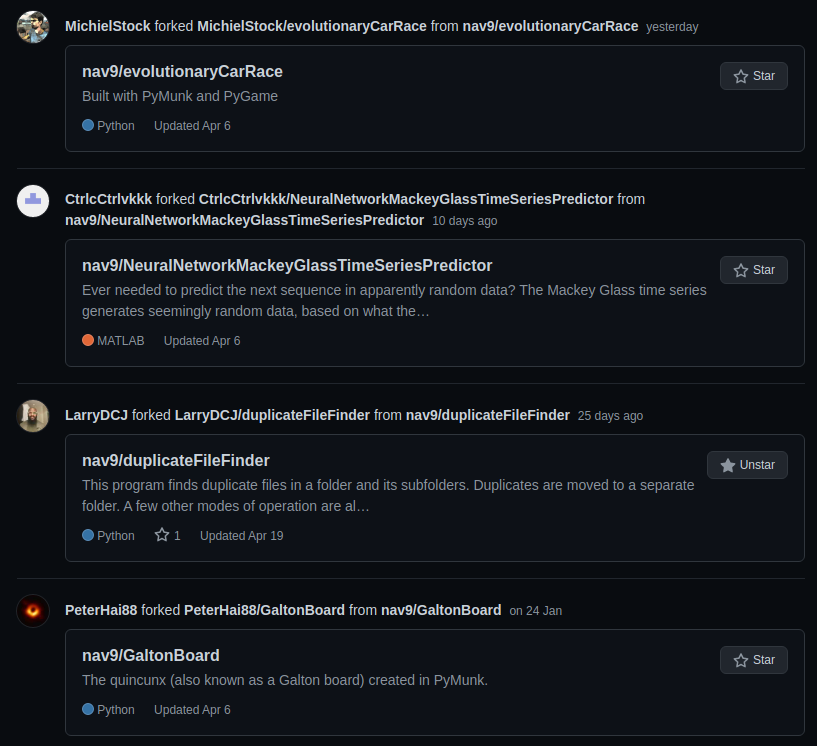
Yesterday, I noticed that some of my repositories were being forked. Happy that the programs I developed are of use to the community. 


The file duplicate finder is a program I'd encourage people to use (and from the fact that an issue was reported, it looks like people are finding the project and hopefully finding it useful). Sometimes we have a lot of duplicate files and images lying around in various devices. This program helps identify and consolidate them. 


When looking at how often people contribute code:

I just noticed, that my public view of GitHub commits, does not show what is going on in the private repositories (which show a lot more commits). This is something recruiters would benefit from keeping in mind.

Public View

Private View (the actual number of commits)


22 April 2021

WindowsXP image resizer powertoy equivalent for Linux

Windows XP's powertoy for resizing images was so convenient and popular, that people demanded it for future versions of Windows too. Linux however, seemed to lack such a feature, and people used to suggest using a bash script or GIMP to perform batch conversions.

There's a far simpler way now. Bitron software created Nautilus Image Converter which when installed, gives you image resize and rotate options in the right click menu itself. Really handy.


For Ubuntu, install it using:

sudo apt install imagemagick
sudo apt-get install nautilus-image-converter
nautilus -q

For Linux Mint, install it using:

sudo apt install imagemagick
sudo apt-get install nemo-image-converter
nemo -q


The "-q" is to stop nautilus (the file manager for Ubuntu that's the equivalent of Windows Explorer) or nemo (the file manager for Mint). You can restart the file manager by just clicking on any folder or the "Files" icon or by opening a terminal with Ctrl+Alt+T and typing "nautilus". 

Now when you right-click on images, you'll see a "Resize images" option. So simply select all images and resize them.

24 March 2021

How to show the commands being executed during Ubuntu startup?

There are times when while booting Ubuntu, it may take a rather long time to boot, and you'd wonder what's holding it up, but the purple splash screen that acts like a curtain, does not show you what's going on in the background.

Here's how you remove it:

sudo gedit /etc/default/grub

Comment out the line which has "quiet splash" and create a new line with an empty string.

#GRUB_CMDLINE_LINUX_DEFAULT="quiet splash"
GRUB_CMDLINE_LINUX_DEFAULT=""

Save and exit.

And it's necessary to update grub to retain the changes, else when you restart the system, the changes you made will disappear.

sudo update-grub2

02 February 2021

Changing the colors in Pandas boxplot

 Normally, it's just one Google search that gets you to a good example for plotting any graph using Pandas or Matplotlib. Not so for boxplots. Every example I saw was ordinary and didn't show the advanced options for colouring the plot. So here's a quick demo:


import math
import pandas as pd
import matplotlib
import matplotlib.pyplot as plt
#Named colors: https://matplotlib.org/3.1.0/gallery/color/named_colors.html

data = {"A": [1,2,3,4,10,56,32], "B": [2,4,6,3,2.4,0,0], "C": [1,4,0,10,20,5,2], "D": [2,3,6,2,3,40,-1]}
for k in data.keys():#convert the zeroes to NaN, so that it does not mess up the boxplot
    data[k] = [x if x != 0 else math.nan for x in data[k]]
figWidth = 4; figHeight = 4.1;
boxproperties = dict(linestyle='-', linewidth=1.5)
medianproperties = dict(linestyle='-', linewidth=1.5)
flierproperties = dict(markerfacecolor = 'lightgrey', markeredgecolor = 'lightgrey')
colors = dict(boxes='dimgrey', whiskers='darkgray', medians='yellowgreen', caps='dimgrey')
df = pd.DataFrame(data, columns=list(sorted(data.keys())))
df.plot.box(grid=False, patch_artist=True, showmeans = False,
            sym='.', color = colors, boxprops=boxproperties,
            medianprops=medianproperties, flierprops = flierproperties,
            figsize=(figWidth, figHeight))
plt.title("values")
plt.ylabel("y label")
plt.xlabel("x label")               
plt.savefig('myPlot.eps', format='eps', dpi=1200)
plt.show()   


There are of course more styles that could be presented.


Say thank you or donate

01 January 2021

What technical pre print repositories accept unpublished research?

In academia, it is very important to be ethical and to ensure your ideas are not copied or scooped before you can prove that you came up with the idea first. To enable this, pre-print repositories like ArXiv were setup to give research work a timestamp when submitted. This could help any researcher prove that they came up with an idea first. Any work found on a pre-print repository is not a credible source of information, since it has not yet been peer-reviewed. However, since ArXiv has a very strict moderation policy that results even in experienced scholars having their papers rejected, ArXiv does not fulfill the purpose of being a pre-print archive. The delay in moderation, the need for endorsement from somebody else and the rejection can just end up allowing time delays that can result in work getting scooped. Many other pre-print repositories have come up, and it's considered ok to upload your research paper to multiple repositories.


Some of these free repositories are:
  • ViXra: This pre-print repository is far more accepting than ArXiv, and was created as a means of allowing genuine research work to get a timestamp. I found their FAQ to be far more insightful and enlightening than any other pre-print's FAQ. I encourage reading their FAQ. It mentions a lot of useful information about what you should and should not do with your pre-prints. I feel ViXra is one of the only pre-print repositories that actually honors the purpose of being a pre-print repository. Hence, this is the only repository I would trust, because I know that when I submit a genuine paper to them, they will give me a timestamp for my work instead of delaying it or rejecting it.
  • TechRxiv: A pre-print repository setup by IEEE. I've found them to be good, but there are chances of a reviewer not accepting a paper and having to appeal to the editor until they allow a re-upload. The whole process can take a few weeks...enough time for getting scooped in some fields.
  • IndiaRxiv: I was pleasantly surprised to find one for India. It's part of OSF, which accepts papers from multiple disciplines.
  • HAL: This is a well known repository with moderation and it is said that they also allow you to transfer your paper from HAL to ArXiv.
  • EngrXiv: This is also part of OSF, and has been gaining traction with researchers.

Some precautions before submitting to a pre-print
 
Remember that there are some journals and conferences that do a double-blind review of your paper, and they will not accept a paper that is uploaded to a pre-print repository. so if you plan to submit to a certain journal or conference, first check their website or write to them asking if they allow papers that are on a pre-print repository.
A quick way to search is by using Google's tools:
site:journalWebsiteName.com arxiv

Careful of predatory journals or conferences

Some journals will offer to get your paper published for free without any peer review process. Avoid such journals. It can lower your academic standing. I was contacted by one such journal which quoted an ISSN number on their website. When I searched, I realized that such an ISSN number didn't even exist!!! Always make sure your work is properly peer reviewed by reputable journals. In the tech world, journals with a Scopus index are safe.


In conclusion
 
Writing research papers is a time-consuming and cumbersome process. All that hard-work should not go for a waste. Pre-print repositories are a very useful means of proving precedence of your idea. They are also meant for inviting comments from colleagues, before you decide to submit it to a conference or journal. Websites like ResearchGate will automatically detect your work on pre-print repositories and link it to your ResearchGate account, making it easy to share your work and to invite comments on ResearchGate, because it automatically notifies the authors you have cited in your paper.
To simplify people's research process and to make available information on research and publications, I've curated a small collection of helpful documents from multiple people.


ps: On a more personal note, I feel that researchers who advance the knowledge of mankind and who are the backbone of the technological capability of society, need more respect and recognition in society. The level of detail they go into, the expertise they acquire in each subject and the rigor of research makes them an elite force. It's unfair that companies and publishers make profits form their ideas but the researchers don't profit from it. How did researchers even agree to such a raw deal? Publish or perish? I dearly wish that the world figures out a way to ensure that researchers are able to monetize their contributions much better than they currently are. If not that, then at least provide them privileges and conveniences that make life easier for them. All the benefits of technology we enjoy are because of them. We must never forget the shoulders we stand on.

24 December 2020

The better way to calculate permutations programmatically

When wanting to calculate factorials and permutations, I was surprised that C++ didn't have a built-in function to do it. Sure, it's a simple function, but cmath could have had one instead of expecting users to write their own function. Anyway, I created a class for it and soon realized that even unsigned long long was unable to hold the large numbers that I was calculating permutations for.

This led me to the online calculators, which did ok for conditions like 81 numbers taken 81 at a time (which gives a huge result: 5797126020747367985879734231578109105412357244731625958745865049716390179693892056256184534249745940480000000000000000000).

However, calculations like 129600 taken 2 at a time, were not supported, so when I searched for which programming language could help, I found that Python was just perfect for this. Turns out, numbers in Python are only limited by the amount of RAM you have. Intelligent people, these people who maintain Python. 

Python does have a limit on how deep your recursion can go, so rather than use recursion to calculate factorials, it's better to use the humble for loop. Here's how it's done:

def factorial(n):
    fac = 1
    if n == 0:
        fac = 1
    else:
        for i in range(n,0,-1):
            fac = fac * i
    return fac

print("To calculate permutations:")
print("n!/(n-r)!")
n = int(input("Enter number of possibilities (n): "))
r = int(input("Enter how many at a time (r): "))
print("Permutations: ", factorial(n)/factorial(n-r))


11 November 2020

The Real Cure for Eye Strain

When faced with eye strain, should you use eye drops, new spectacles, do eye exercises and work harder or should you take rest?  

Some more info:

Consider it this way: if you ran a marathon everyday even if your legs were paining and cramping, would you do more leg exercises, use crutches and apply oil on your legs to continue the marathon, or would you take rest? The marathon is an analogy to the way we use our eyes without taking rest. The crutches and oil are an analogy to how we use spectacles, eye drops, eye exercises, blue light filters etc., hoping that it would cure us. 

(blue light filters were researched and there was no evidence of it being effective: Paper1, Paper2, more citations).

Sure, if the strain is mild, some remedies do appear to give a little relief, but they are only treating the symptoms. We should not pretend that it is working. We need to treat the root cause and cure it. I realized after a decade of chronic eye strain, that there's an obvious, common-sense first-step to the healing process.


Discovering the truth

Doctors tend to focus on intraocular muscles. A less considered fact is how extraocular muscles (shown in red) are affected. I’ve felt excruciating pain in those areas for many years.

In my case, it began with a burning feeling at the front of my eyeballs. Then came the light sensitivity, occasional sharp pains at the sides of the eyeballs, which became sharp stabbing pains all around and behind my eyeballs. I ignored that too and continued working. Then came severe pain all over the eyes, eye muscles twitching, tightness at the cheek muscles that even spread to the forehead muscles. The sharp stabbing pains continued, and my eyes were paining every waking minute of the day. I found it difficult to even keep my eyes open for too long. This is what chronic eye strain feels like. During the next few years, I consulted plenty of doctors (even at highly recommended eye specialty hospitals). They examined my eyes and found no defect other than myopia. No doctor had even heard of such a severe case of eye strain. They tried their genuine best to help, and I could see they felt bad, because they wanted to help me recover (bless them), but they didn’t know how to cure me. Medical science doesn’t seem to have given enough attention to the root causes of fatigue-related eye strain. Practitioners of ancient traditional medicine couldn’t help either.

My eyes just continued aching and burning every single day, throughout the day for six more years, and I continued using the computer for many hours as usual, despite the pain…because I thought I had no other option. Added to that was the mockery from many who thought I was exaggerating.

The persistent pain finally drove me to note down daily experiences. Over a period of few years, multiple experiments, correlations and keen observation, coupled with consultation with a doctor, I finally found the cure and started recovering.


The Cure

It’s necessary to follow these points very strictly. Depending on the level of strain, it can take anything from a few months to few years to get cured, but this is the only way to cure fatigue-related eye strain. Nothing else works.

Table created by Hirshkowitz M, et al.(March 2015)
 

  1. Eight hours of uninterrupted sleep every night: This is the foundation. Without this, nothing else will cure the strain. We assume we are getting enough sleep because we feel refreshed when we wake up…and then don’t notice that we still feel sleepy during the day. Before my eye strain became chronic, I hadn’t noticed I was getting only 4 or 6 hours of sleep for many months (a polysomnography didn't help, since doctors were blissfully unaware of what to evaluate for fatigue-related eye strain). During my own experiments, I noted that it was only after 8 hours of uninterrupted sleep, that my eyes felt fine. Interruptions in sleep or short duration of sleep does not seem to allow the muscles and tissues to heal (see Allostatic load). Strain appears to accumulate everyday due to lack of proper sleep. You’ll also notice that you are able to see much clearer than usual, after you get 8 hours of restful sleep. Children need more than 8 hours of sleep, and noise etc. disrupts sleep.
  2. Closing the eyes after 20 minutes of strenuous work: Twenty minutes (or lesser) of work followed by closing the eyes, relaxing the face muscles and neck muscles and waiting until the strain subsides (the way we maintain tension in our muscles is a part of the problem). It helps to install software that reminds you to rest at intervals. Even if you don’t feel strained, stop after 20 minutes and rest. It’s necessary. Some people say 40 minutes. That's wrong. It's 20, and it applies even to people without eye strain. The “20” is not some random number. It’s from many years of experimentation. Still, rather than blindly follow a number, pay attention to how much time it takes for your eyes to get strained, and try resting your eyes before the pain starts. There is no work that is more important than your eyes. I’ve tried eye drops, an eye gel, anti-reflective coatings, blue-light reduction, eye exercises, washing the eyes, the 20–20–20 rule, expensive eye glasses and all the other advice that doctors and common folk think is a cure for eye strain. Nothing worked. At my level of severity, even minor differences were noticeable. The ONLY way to rest the eyes and get relief from fatigue-related strain, is to keep the eyes closed until the strain subsides. It's not necessary to rest every 20 minutes for tasks like watching a movie, as it's less strenuous. Pay attention to the tiredness/pain signals that your eyes give you. I created a software named iRest which allows resting the eyes in the right way.
  3. Stop using wrong spectacle lenses: Over many years, I noticed that for strained eyes, computerised eye tests or even a manual eye test were not necessarily sufficient to determine the correct power. When spectacles caused strain, it was important to stop using them, and find out what the eyes felt comfortable with. More details are mentioned in the "Precautions and Observations" below.
  4. A well balanced diet of properly cooked food: It’s extremely important to know that when food is not properly cooked or even slightly burnt, it causes discomfort in the digestive system (most of the time you won’t even notice this discomfort) that leads to sleep loss (I’ve mentioned more about this in the stomach test blog post). I have noticed muscles feeling less moveable after certain foods or contaminants in foods affect the body. I'm still trying to figure out the what and why of it. Take some extra time to chew your food well. Also, ensure you search the internet and understand what a “well balanced diet” means, and why it’s important. Instead of searching only for foods that can help the eyes, make sure your entire body gets the nutrition it needs. Bodily functions are highly interconnected. When muscles go through strenuous activity, they need a proportional amount of protein (There’s a wide variety of proteins. Chicken meat worked best for me. I have no clue about what protein sources would work for vegetarians). The body also needs natural foods that help with long duration sleep and deep sleep.
  5. Disbelief in magic: If you wish for a quick magical cure, you could get misled by people selling such “cures”. Magical eye drops, magical monitors, magical spectacle lens coatings, magical spectacle lenses, magical supplement tablets, etc. It’s like having a fractured leg, using a bandage that promises to cure leg pain, and running a marathon everyday, while complaining that the leg pain isn’t reducing. If your eyes are burning/paining frequently, you’ve likely entered an acute (recovery takes weeks or months) or chronic (recovery takes months or years) stage of strain. You may recover faster, but since my strain was extremely severe, it took 3 years for the constant soreness of my eye muscles to stop, and it stopped only because I strictly followed the 3 points mentioned above. Prior to the 3 years, I suffered the pain for 6 years because I didn’t stop the long hours of computer use and didn’t ensure that I got proper sleep. To recover, you need patience and discipline. Not magic. The earlier you start, the faster you'll recover. When the body needs rest, give it rest. Any other work can wait. Else, you’ll end up with a severe burnout that will prevent you from working anyway. It’s not worth permanently damaging health for any company. You can always find another job, but if you ruin your health you could end up permanently crippled. Definitely not worth damaging your eyes for playing games.

Eye strain and myopia can be caused by many other factors too. Those are best diagnosed and treated by a qualified ophthalmologist. Everything I’ve mentioned here, is only for eye strain that’s caused by excess fatigue to the eyes and lack of sleep.


Precautions and Observations

  • No eye exercises: Tired muscles need rest. Not exercise. When your eyes are strained, do not do eye exercises. Just close your eyes to rest them.
  • Full body exercises: It was of no use in curing or reducing eye strain, and it resulted in better sleep only during the first week. However, full body exercises are very necessary for general health.
  • The “SCREAMING”: The pain/burning/discomfort is basically your eyes screaming at you, begging for rest. Never ignore or delay it.
  • Prevention better than cure: Instead of allowing eye muscles to cross the threshold of endurance and enter a state of pain, and then using eye drops or warm compresses to soothe the pain, it’s far better to rest your eyes before the pain starts. I have not needed eye drops ever since I ensured I took periodic rest and got proper sleep.
  • 20–20–20 rule is wrong: The right way to do it is to close the eyes, relax all muscles, and wait for as long as it takes for the strain to reduce. Later I found out that the creator of the rule himself said it is flawed.
  • Digital screen settings: It helped a little bit when I reduced my computer and smartphone brightness to the lowest level I was comfortable with, and used the monitor’s preset “warm” setting. Alternatively, the free night-filter/red-shift apps are also good, but these won’t cure strain. What also helped, was positioning the screens in such a way that reflections on the screen did not cause glare. Anti-glare coatings did not reduce my strain even a little bit because digital screens or blue light was not the reason for strain. Strain was caused by the lack of periodic rest and sleep. 
  • “exact power” myth & “wear always” myth: My eye power is measured -4.5 (right) and -4.75 (left), but my eyes feel comfortable only if both spectacle lenses are -4.5. Also, for near-work (like computer use or reading the newspaper), my eyes are a lot more comfortable with lenses of power -2 (ordinary glass lens spectacles without any coatings, purchased in 1998, and I’ve had absolutely no problem using a lower power). When eyes are strained, lenses of a power lower than the measured eye power have been a lot more comfortable. Sadly, many people are not being informed that severely strained eyes are a lot more sensitive. They remain stuck with the wrong belief that the lens power needs to be exact, and followup treatments revolve around lens power instead of realizing or checking that the primary cause of the strain may be the severe lack of sleep/rest/nutrition. I’ve also realized that it isn’t necessary to wear the spectacles always. When reading a book or viewing my phone, or walking around my house, I don’t need spectacles. However, when safety is important (like driving, etc.), I use spectacles of -4.5.
  • Dry eyes: It was extremely rare, and happened only when I lost sleep or when my eyes were over-strained. When I took rest, it always got resolved on its own within a few hours. Doctors found my tear film to be normal. Don’t forget to drink sufficient water and blink.
  • Proper lens alignment: Even some expensive frames are designed wrongly. Even experienced opticians fit lenses at incorrect angles. It is astonishing how many of them don’t care, and tell people that nothing will happen, just to make a sale. Ensure that the lenses are properly aligned.

  • Incorrect diagnosis: Doctors seem to assume astigmatism, or that the eye power is higher than what it actually is, when patients complain of eye strain (one doctor even jumped to the conclusion that I had dry eyes, even though I didn’t). Strained eyes can result in significant variations in eye power. It does not mean that one needs to immediately switch to new lenses. It’s important to reduce the strain first by getting proper sleep and rest. Doctors need to create/follow a standard practice of first ensuring the patient reduces the strain by getting proper sleep and rest for many days, and only then do a refraction test. During severe strain, even a refraction test done after pupil dilation can show the wrong power. There exists a phenomenon where the cramped/strained muscles cause the power to rise a little, and many nights worth of proper sleep relaxes those muscles and the power returns to what it was before the strain became severe. The power won’t reduce lower than that though. Doctors even prescribed cylindrical correction lenses which I couldn’t tolerate for even a few minutes (I detected the discomfort early because my eyes were already very severely strained. Like how simply touching a wound, hurts badly. I wonder how many people with lesser strain end up trying to tolerate such lenses because they don’t realize that it’s the wrong power). Even computerized eye tests and the pupil dilation test showed astigmatism and the wrong power. Oddly, every doctor gave me a slightly different eye power prescription, and each time, the cylindrical correction angle was different from the previous reading. I started spending most of my days either not wearing spectacles or using spectacles of a lower power (which didn’t cause any issue, by the way. It actually gave more relief), and when I started getting better sleep and rest, the strain reduced. This time, after getting a good night’s sleep, when I went to the doctor with well-rested eyes, my eye power was diagnosed correctly. Three doctors eventually concluded that I don’t have astigmatism. Over a period of time, my high level of strain helped detect and eliminate many misconceptions (which are still floating around). One doctor even recommended an MRI, but my family doctor told me not to, because there’s no point doing an MRI if you don’t know what you are looking for. One doctor prescribed antidepressants, saying the eye strain may be anxiety-related. My family doctor who couldn’t reach a conclusion, eventually said the stomach issues and eye issues may just be psychological. Doctors really need to receive more training to be better at diagnostics. To consider the entire case-history and lifestyle of a patient, and to be willing to look beyond the textbook.
  • “Is this lens better or this one?”: As long as the spectacle lenses feel right, that’s the eye power to stop at (for driving etc. 20/20 vision from spectacles is obviously required. Commonsense). When my eye power was -4.25, and the doctor added another lens to make it -4.5 and asked whether the higher power was better, it appeared clearer and sharper to me (I didn’t realize it was too powerful), so I chose -4.5. I shouldn’t have done that. -4.25 was the correct power. When using the computer, I switch to -2.0 power ordinary glass lens spectacles without any coatings, and I’ve had absolutely no problem (spectacles purchased in 1998). When eyes are strained, lenses of a power lower than the measured eye power feel a lot more comfortable. Some people recommend wearing spectacles even if it feels uncomfortable or if it gives a headache, saying that the eyes would adjust after a few weeks. That’s very wrong advice. There are three scenarios I know of that causes this. 1. The lens power prescribed is wrong, or 2. The lenses are not aligned correctly, as shown in the image below, or 3. The eye muscles are too strained and sensitive to adjust to new spectacles. In the first two situations, I learned not to wear those spectacles. It caused more strain. In the third situation, it was necessary to wait until the strain reduced, before trying the new spectacles. A fourth possibility could be that a poor quality lens may be refracting light unevenly. Doctors need to look beyond the theory they studied, and get feedback from patients to understand the reality, and that the evaluation methodology of many researchers lacks knowledge about the ground realities (more info here).
Spectacle lens fitted at wrong angle

Sometimes, the spectacle lens ends up at a slightly incorrect angle. This image shows one axis. The angle variation can happen along other axes too. This caused my eyes to get strained faster. Don’t try to adjust to it. Ensure that an optician fixes the error or get a new frame/lens. Also, there are a lot of measurements that need to be done accurately when selecting the focal point, frame width and fitting the lens to the frame.


  • Low power prescriptions: I’m hearing of a lot of people being prescribed -0.25 or -0.5 prescriptions for one eye or both eyes. Even a cylindrical correction, just because they complain of eye strain. Please consider that these powers may just be a result of excess strain and/or lack of sleep. Wouldn’t wearing spectacles constantly prevent them from recovering to normal sight? We need to do better research and make life livable, to rescue people from poor habits that lead to weak vision, instead of providing people with spectacles at the slightest excuse.
  • Bad habits from childhood: For goodness sake, please don’t mess up children’s sleep cycle. Not even for exams. Hard work is good, but losing sleep repeatedly to do hard work is foolish. Right from childhood, we have been taught to ignore discomfort and persevere, but we should have also been taught to recognize when we should stop and give our body the rest it needs.
  • Work environments: Even in the most well-meaning work environments, bosses are pushed to deliver results quickly. But that doesn’t mean you need to damage your health in the process. Six hours of computer use a day is what I’d say is the safe-limit (eight hours may work for you, but never skip the rest breaks). When recovering from chronic eye strain though, not more than 4 hours is what I found is best. The entire world is realizing this necessary truth, and you shouldn’t be ashamed to take rest. Being a responsible person who gives their body the rest it needs is one thing. Laziness is an entirely different thing. Any sensible boss or colleague will know the difference.
  • Online classes and smartphone/TV use: Teachers and parents need to ensure that students get some necessary breaks during online classes, smartphone use or while watching TV. Kids by nature won’t listen, but please ensure they get their rest, sleep and nutrition. Their disappointment at not being able to play video-games for long, is tiny compared to the disappointment of having to wear spectacles lifelong. The need to wear spectacles itself shows that the eyes are seriously affected. Don’t make it worse. Better still, don’t even allow it to reach a stage where anyone needs spectacles. Protect the eyes.
  • Daytime sleep: If you couldn’t get proper sleep at night, you will feel sleepy during daytime. It is extremely important to take that nap. It gives some very essential rest for the eyes that’s even more effective than just keeping the eyes closed. 
  • Blue light and sleep: My experiments did not corroborate the studies that claim that blue light exposure late night causes sleep loss. What does affect sleep, is the amount of interest I have in something I do before sleep, which makes me force myself to stay awake. What I consume and how late in the night it is consumed also affects how late I fall asleep.
  • Coffee/tea: When the body badly needs rest and you feel sleepy, you should sleep. Drinking coffee or tea to remain awake is a silly thing to do.
  • The angle: If you extend your hand in front of you and hold a dumbbell for long, your muscles will start aching after a while. When it starts aching, if you raise your hand to hold the dumbbell above your head, some of your arm muscles will be spared of the weight of the dumbbell and get a chance to relax. The extraocular muscles holding the eyeball, are like the arms holding the dumbbell. Closing your eyes and lying down facing the ceiling helps those muscles relax a little bit (it gives just a slight bit of relief).
  • Spectacles are not a cure: Some people assume that if they constantly wear spectacles or contact lenses for a few years, they will get cured to normal sight. It won’t. I've never tried "print pushing" though, but in the case of strained eyes, the first priority should be to allow the eyes to heal by getting proper sleep.
  • Glass lenses are better: The medical and optical community is largely unaware of how distortions in refraction affects strained eyes. During my chronic levels of strain, plastic lenses always caused my eyes to get strained quicker than when I used glass lenses. For some years, the discomfort was instant. Even Jack reports similar issues. Not wearing spectacles gave the most relief. Now that I’ve recovered a lot, I experience the strain a bit lesser, but long hours of strain add up quickly, so I still prefer glass lens. Glass is well known for offering better visual acuity and lesser distortion (provided it is of good quality). Of course there’s a safety benefit to plastic lenses, but while sitting in front of a computer, glass works best for me. Some opticians may bluff, saying that glass lenses are not available. It is available and can be half the price of plastic lenses. Do spectacles really need to cost as much as a phone?

A certain company handbook I saw recently, mentioned that employees were only entitled to a ten minute break every two hours. A classic example of how rules are formulated from poor knowledge on Repetitive Stress Injuries. Please realize the seriousness of the matter and establish processes that help in creating a nation of healthy people. This also goes for everyone who knowingly or un-knowingly deprive people of sleep and rest right from childhood.

The human eye was not evolved to handle this kind of strain. Too many people are getting incorrect advice and hurting their eyes. Please tell more people about getting proper sleep and rest. There are not enough doctors emphasizing this.

Like someone once said: 

If you do not give time for wellness, you will be forced to make time for illness”.


CAUTION

Don't give up too soon. It can take several weeks/months to recover from acute strain, and it takes several months/years to recover from chronic strain. I initially took a 15 day vacation to check if it would cure the strain (during which I continued using the computer a lot). When it didn’t, I assumed that taking rest was of no use. I didn’t realize that I had severe sleep loss and was still overworking my eyes. The strain had built up to such a severe stage that longer periods of rest and sleep were required. The right thing to have done would have been to take a sabbatical for a year to ensure I got rest. Due to ignorance and bad advice, I continued working, and the problem persisted for several years. This applies even to conditions like back pain etc. When the body needs rest, give it rest. Any other work can wait. Else, you’ll end up with a severe burnout that will prevent you from working anyway.

p.s.: Do read through the article a few more times to understand all points, and when you get cured, please return to leave a comment. I recovered fully in October 2022. An ordeal that started in July 2011, and wrecked my career. It was prolonged due to the poor medical advice I received, the marketing nonsense that lies about being able to cure the strain, and due to the glaring lack of a support system in companies and in society.


Medical science is a science. Not a superstitious cult. That’s why doctors and researchers need to be open to new information and confirm it with experiments that are conducted using the right parameters and without bias. Helping people heal is important. History is witness to errors and corrections related to saturated fats, blood circulation, and more. Similarly, there is much that needs to be done to correct existing literature and help people avoid eye strain. I hope the medical community gives a priority to people’s health and to the spirit of scientific research.


Keywords: computer eye strain, eye strain glasses, eye strain headache, reduce eye strain, eye strain causes, digital eye strain, eye strain from computer, glasses for eye strain, eye strain relief, eye strain in one eye, what causes eye strain, eye muscle strain, how long does eye strain last, why do my eyes hurt, eye drops for eye strain, glasses for computer eye strain, how to get rid of eye strain, burning eyes, eye drops for burning eyes, pain in eye, pain behind eye, right eye pain, left eye pain, headache eye pain, sharp eye pain, eye pain causes, sharp pain behind right eye, pain relieving eye drops, home remedies for eye pain, eyes hurt, pain above right eye, pain in eyeball, pain over left eye, how to relieve eye pain, how to stop eye pain, reason for eye pain, medicine for eye pain, eye pain home remedies, eye strain symptoms, headache and eye pain, eye socket pain, stabbing pain in eye.


02 October 2020

Install PyEnv if you want various Python versions on Ubuntu

One of the major issues with installing new versions of Python is that if you try removing it or try removing the existing version, it'll cause problems with the working of the operating system, because Ubuntu uses Python for many of its system functions.

As an alternative, people suggest using Anaconda or Miniconda. When I tried it, I ran into errors where the package versions installed with Anaconda conflicted with the system Python versions. At my wit's end, I finally gave PyEnv a try and it worked beautifully. (Also have a look at Poetry)
  1. sudo apt-get install -y make openssl build-essential libssl-dev zlib1g-dev libbz2-dev libreadline-dev libsqlite3-dev wget curl llvm libncurses5-dev libncursesw5-dev xz-utils tk-dev libffi-dev liblzma-dev python3-openssl curl
  2. curl https://pyenv.run | bash
  3. Follow the instructions shown on the terminal to add commands to bashrc. If you see any warning messages, follow the advice mentioned in the message. Close terminal. Open a new one. 
  4. sudo apt-get install -y gcc make zlib1g-dev libreadline-dev libreadline8 sqlite3 libsqlite3-dev libbz2-dev python3-tk tk-dev
  5. pyenv install --list to see the latest versions of python available.
  6. pyenv install -v 3.14.0  (or install one of the latest versions or any other, but do remember that the higher versions of Python would need higher versions of dependent libraries which may or may not be available with the version of Ubuntu you have installed)
  7. pyenv global 3.14.0
For Raspberry Pi
The procedure is given here. The system packages needed were just:
 
sudo apt-get install --yes libssl-dev zlib1g-dev libbz2-dev libreadline-dev libsqlite3-dev llvm libncurses5-dev libncursesw5-dev xz-utils tk-dev libgdbm-dev lzma lzma-dev tcl-dev libxml2-dev libxmlsec1-dev libffi-dev liblzma-dev wget curl make build-essential openssl 
 
Useful commands:
  • To see which versions of pyEnv are installed: ls ~/.pyenv/versions/ or pyenv versions
  • To remove any version: pyenv uninstall 2.7.15 or rm -rf ~/.pyenv/versions/2.7.15
  • Check which is the system default version: python -V
  • To revert back to the default system python: pyenv global system
  • Commands available with pyenv: pyenv commands
  • Getting help for any of those commands: pyenv shims --help
  • Check if pip is installed: pyenv which pip
  • Set a global version: pyenv global 3.6.8
  • Set a local version for a specific application's directory: pyenv local 2.7.15
The most impressive parts of PyEnv are the ability to switch between Python versions and have separate local and global versions.
Although the next step would be to install a virtual environment using pipEnv, I didn't like it because the updates portion is poorly implemented. There's also venv you could try.

05 September 2020

Keyboard cleaning

The good thing about freelancing is that one gets a good amount of spare time to relax the eyes and go for a digital detox. Add to that a global pandemic, and you get to learn some new things.
I decided to open my keyboard which had been gathering dirt for many years. Here's the "before" picture.


Opening it up showed how much dirt had accumulated over the years. But I also noticed that the reason that the keys didn't have a smooth movement when pressed down was not the dirt. It was because they had to slide down the plastic, and there was no lubrication.


This is the membrane the keys push down. It's a "dome switch" which completes the circuit when the finger presses it down.


The circuitry under the domes. I was surprised at how minimalist it is.


A word of caution. When removing the key caps, don't use a compass or an object that exerts force at a single point, because it'll cut a groove in the plastic, as shown in the image below. It's better to use an old debit card or a professional key cap remover or even make one yourself using metal wires.


After cleaning and drying, the keyboard looks good as new!!! I wanted to apply some grease too, but some forums and comments warned against using grease or oil without first checking how it'd affect the plastic.


Don't forget to take a photo of the keyboard before opening it up. It'll help when you are putting back the key-caps.
Next time I'd go for either an ergonomic mechanical keyboard or a buckling-spring keyboard.
 
[update: Jan 2021: Since the keys felt difficult to use as the plastic was scraping against plastic, I took off the key-caps again and used a small paintbrush to apply a thin layer of grease at the portions that were scraping. It worked really well after that. Do take care that you shouldn't use grease that affects plastic negatively].

09 August 2020

Saying Thank You

I chose to share knowledge with you for free, without ads and without a pay-wall. I'm grateful to the few people with hearts of gold, who at least stop by to say thanks for the amount of effort I put in to help save your time and effort.

and/or


02 August 2020

When using the Hemmingway Editor, take the grading with a pinch of salt

For writing assignments, many people recommend the free Hemmingway editor, which help remove unhelpful adverbs, passive voice and in general, helps improve your sentences by making them simpler and easier to read. These features are really useful.

However, recently when I wrote some simple sentences, the editor said they were at Grade 11, when these were simple sentences that even a 7th or 8th grader could understand. So I did a little experiment. I chose sentences from two children's books and checked to see what Hemmingway editor would report.

First book: The call of the wild.

This is a version simplified for children, meant for 3rd, 4th or 5th graders. While most paragraphs showed a “Grade 5” or “Grade 6”, a sentence whose only fault was that it was too long, showed a “Grade 7” difficulty.


Moreover, copying and pasting the same sentence repeatedly, brought the score up to Grade 11. From there, it was not difficult taking it up to Grade 13. This is a serious flaw in the algorithm.


Second book: Chips (story of a rabbit).

This book has very simple sentences meant for children in the 2nd or 3rd grade. While most paragraphs showed grades ranging from “Grade 5” to “Grade 9”, some sentences gave these results:


Oddly, removing a few sentences brought it to Grade 10.


Removing more sentences pushed it to Grade 11.


By repeating the same sentence, I could push it to Grade 14.


I've written to the creators of the editor, showing them these examples. Hope they'd correct it soon. Meanwhile, writers should take the gradation score with a pinch of salt. The editor is still a good method of evaluating your text for the other features it provides.

01 July 2020

Repairing grub in a dual boot system without using Boot Repair

After installing Windows, installing Ubuntu detects Windows and installs fine, giving you a dual boot system. But if you re-install Windows or install another OS on another partition, chances are you'll get a MokManager error that looks like this:


Before attempting to repair Grub2, go to your BIOS (as shown in this page) and select the grubx64.efi file or whichever efi file is relevant to your installation, and reboot. Chances are that the non-booting is just being caused because the computer does not know which efi file is safe. I think this happens due to secure boot being enabled, but please don't disable secure boot. Just specifying the correct efi file may help.

If it still isn't booting and you want to repair Grub2, follow the steps in this or this website. I had tried using Boot Repair, which worked nicely, but only once. So I now prefer doing it manually.

Steps:
1. Boot from a live CD or live USB which has the same Ubuntu version as your latest installed Ubuntu.
2. Use sudo fdisk -l and sudo blkid or GParted to determine which sda Ubuntu is installed on. Let's assume it's on sda4.
3. sudo mount /dev/sda4 /mnt
4. for i in /sys /proc /run /dev; do sudo mount --bind "$i" "/mnt$i"; done
5. If Ubuntu is on an efi partition (check using sudo fdisk -l | grep -i efi), mount it with sudo mount /dev/sda4 /mnt/boot/efi.
6. This command won't work if you are using a 32 bit live boot disk on a 64 bit computer, so make sure you use a 64 bit live boot disk: sudo chroot /mnt
7. update-grub (if this doesn't work, goto step 8. Else, step 10).
8. grub-install /dev/sda
9. update-grub. To locate and add Windows to grub menu.
10. If Ubuntu was installed in efi mode, run this: blkid | grep -i efi; grep -i efi /etc/fstab
11. Reboot the computer.

Even now, the "Failed to start MokManager" error may show up. Just go to BIOS and select the right efi file and reboot. Everything should work fine now.
 
Update: If the bootloaders are on separate disks, I've mentioned how to fix it here.


Say thank you or donate